ChatGPT Ads Are Here. Here’s What Marketers Need to Know
ChatGPT is officially moving deeper into advertising.
OpenAI has started rolling out its beta self-serve Ads Manager, allowing advertisers to create, manage, and measure ads that appear inside ChatGPT.
While the platform is still early, this is an important moment for marketers because it opens up a new kind of paid media environment: one built around conversations, intent, and real-time decision-making.
And honestly, that behavioral shift is the bigger story.
People are starting to use AI tools differently than they use traditional search engines. They are not just searching for answers anymore. They are asking questions, exploring options, comparing products, and thinking through decisions with AI acting more like an advisor than a directory.
That changes how discovery happens.
So what does this actually mean for brands? We put together answers to the key questions marketers should be asking before joining the beta.
What types of campaigns are available?
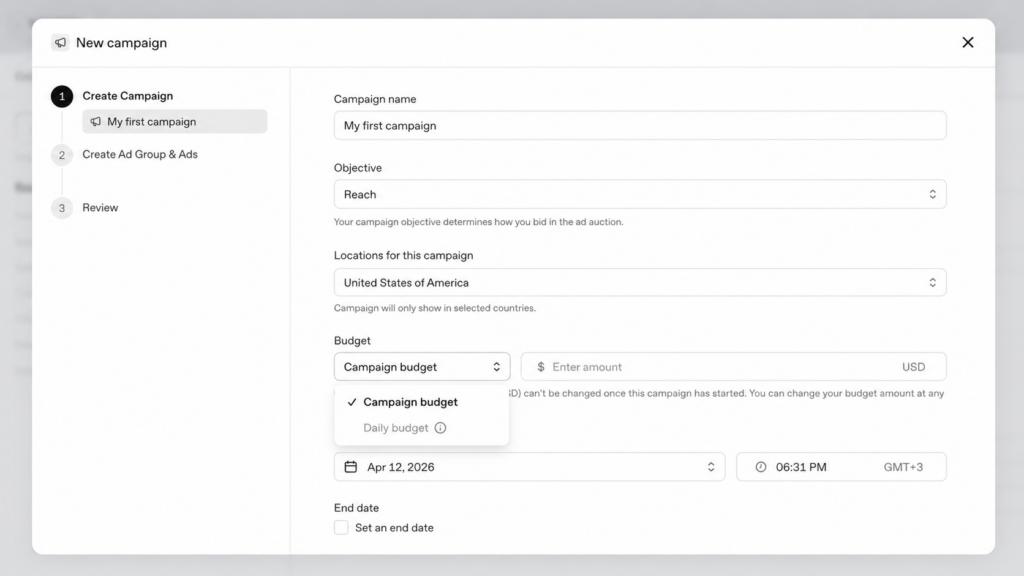
Right now, ChatGPT Ads are focused on three primary campaign types:
Click Campaigns
Designed to drive users from ChatGPT to a website, landing page, product page, or other destination. Brands can use CPC bidding, allowing advertisers to pay based on clicks instead of impressions alone.
Reach Campaigns
Designed to increase visibility and awareness using CPM-based buying.
Conversion Campaigns
While not yet active in the current beta, OpenAI is already building the infrastructure for conversion-focused campaigns tied to business outcomes like leads, sign-ups, purchases, and applications.
What’s interesting is that OpenAI appears to understand something many ad platforms learn later: marketers need more than visibility. They need accountability and measurement tied to real business outcomes.
At this stage, we would think about ChatGPT Ads as an early testing environment for:
- Awareness
- Research-stage influence
- Lead generation
- Landing page testing
- High-intent traffic acquisition
Right now, this feels less like a polished performance channel and more like the early days of paid social: a place where marketers test, learn, and try to understand user behavior before the platform fully matures.
What makes ChatGPT Ads different from Google Search or Meta Ads?
| Platform | Primary Signal | Marketing Role |
|---|---|---|
| Google Ads | Keywords and search intent | Captures active demand |
| Meta Ads | Audience behavior and interests | Creates and nurtures demand |
| ChatGPT Ads | Conversational context | Influences discovery and consideration |
That means ads may appear while someone is actively exploring a topic, comparing options, researching a category, or trying to solve a problem.
That creates a very different kind of intent environment.
It’s not exactly search. It’s not exactly social. It sits somewhere in between: a conversational discovery environment where the user is already looking for guidance.
And from a marketing perspective, that is the real opportunity.
Think about it this way, ads may appear while users ask questions like:
- “What’s the best loan for financing a car?”
- “Which home improvement projects give the best return?”
- “How should I compare local credit unions?”
- “What should I know before buying a boat?”
Those are not passive scrolling moments. Those are active consideration moments.
That distinction matters.
ChatGPT may eventually become a place where brands influence customers earlier in the decision-making journey, while people are still framing the problem and trying to understand their options.
What do ChatGPT Ads look like?
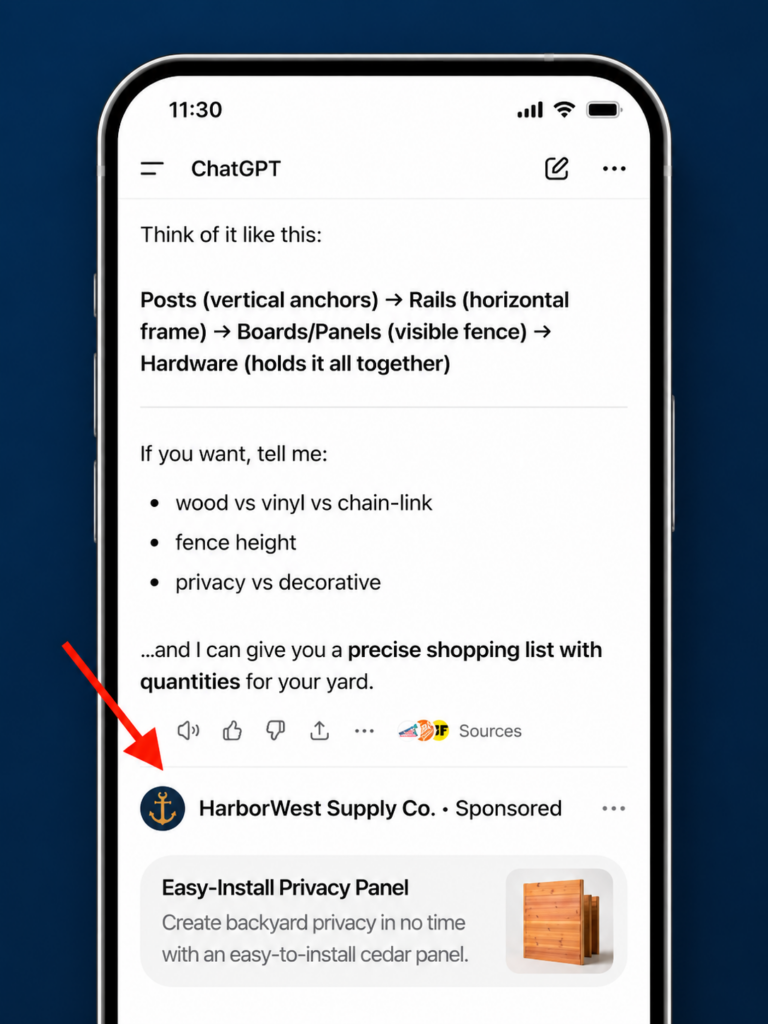
ChatGPT Ads appear separately from ChatGPT’s responses. They are clearly labeled as sponsored and visually separated from the answer itself.
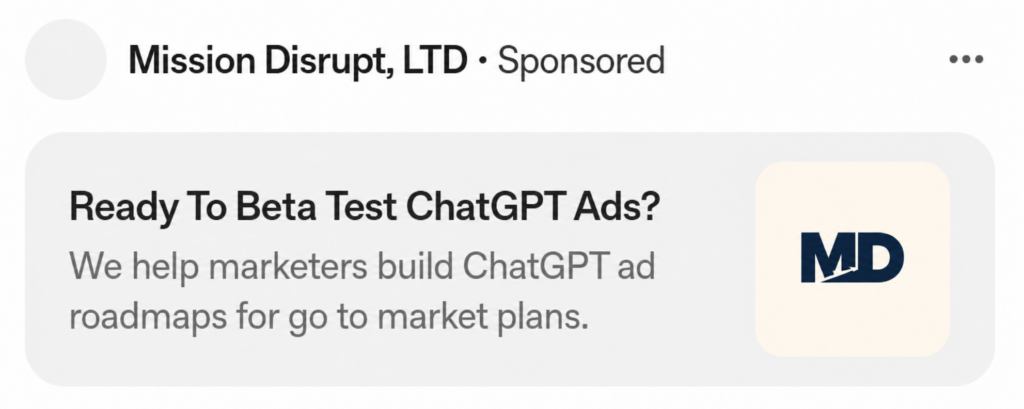
During the current beta, ads may appear below the end of a response.
OpenAI has also stated that ads do not influence or alter ChatGPT’s answers, and advertisers cannot pay to shape the response itself.
That separation is going to be critical if OpenAI wants users to continue trusting the platform.
This is important because ChatGPT Ads are not “paid answers.” They are sponsored placements that exist alongside the experience, not inside the response itself.
That may sound like a small distinction, but from a trust perspective, it is a very big one.
What type of targeting is available for ChatGPT Ads?
ChatGPT Ads currently use topical signals from the conversation to match ads to relevant discussions.
For example, if someone is discussing:
- Home improvement
- Travel planning
- Financial products
- Software tools
- Local services
OpenAI may use those topical signals to determine whether an ad is relevant.
Basic signals like location and language may also be used.
For users who opt into personalized ads, OpenAI may eventually incorporate additional signals over time, including:
- Past conversations
- Saved memory
- Ad interactions
- Engagement behavior
For marketers, this creates both opportunity and uncertainty.
The targeting could become incredibly powerful over time, but it will also force brands to think more carefully about relevance, usefulness, and trust. Interruptive advertising will likely feel even more out of place inside conversational environments.
The brands that win here may be the ones that genuinely help users move forward in the decision process.
What should your ChatGPT Ads budget be?
Because this is still an early beta, brands should treat ChatGPT Ads as a testing channel, not a core budget line item.
For most advertisers, the right starting point is a controlled testing budget focused on learning:
- How reachable your audience is inside ChatGPT
- Which conversational topics drive engagement
- Which landing pages perform best
- How costs compare against Google, Meta, LinkedIn, and other channels
The goal right now is not immediate scale. The goal is benchmarking.
This creates the data needed to determine whether the platform deserves a larger investment over time.
A practical starting point would likely be 5–10% of an experimental media budget. However if you aren’t already spending 250K a year in media spend on your existing channel, you’re likely not maximizing those paid channels yet.
For larger advertisers, there may also be a strategic advantage to testing early. The brands that spend time understanding how people behave inside AI-driven platforms now may be significantly ahead once these channels mature.
For smaller advertisers, the important thing is avoiding hype-driven decision making. This should be tested carefully, measured honestly, and compared against proven channels before larger commitments are made.
How should ChatGPT Ads fit into your strategy?
ChatGPT Ads should not be treated as a replacement for Google or Meta, certainly not yet.
Instead, brands should think about ChatGPT Ads as another layer within the media mix.
The strongest early use cases may include:
Category Education
Reaching users while they are learning about a problem, service, or product category.
Consideration Campaigns
Showing up while users are actively comparing solutions.
Lead Generation
Driving users to:
- Landing pages
- Guides
- Consultations
- Quote forms
- Product demos
Brand Discovery
Introducing your company while users are still exploring options.
Over time, as personalization and measurement improve, ChatGPT Ads may become more effective at helping move users from curiosity to conversion.
The best early strategies will likely focus on helpfulness and continuity.
If someone clicks from a useful AI conversation into your website experience, the landing page needs to continue that same experience. Otherwise, the transition will feel disconnected.
That’s something many brands are still struggling with across paid media in general. This is just going to shine a light on that problem.
How do you measure ChatGPT Ads?
OpenAI Ads Manager currently includes reporting for:
- Impressions
- Clicks
- Spend
- CTR
- Average CPC
- Average CPM
- Conversions
Advertisers can also use UTM tracking inside analytics platforms. OpenAI has additionally launched conversion tracking tools similar to those used across Meta and Google Ads.
In simpler terms, advertisers can measure whether someone who interacted with an ad later completed an important action like:
- Becoming a lead
- Scheduling an appointment
- Signing up
- Starting a trial
- Making a purchase
That matters because marketers have been burned before by platforms that offered visibility without meaningful attribution.
For marketers, ChatGPT Ads should be evaluated the same way any new channel is evaluated:
- Click-through rate: Are people engaging with the ad?
- Cost per click: Is traffic affordable compared to other channels?
- Cost Per thousands (CPM): is reach affordable compared to other channels?
- Landing page engagement: Are visitors staying, scrolling, and taking action?
- Conversion rate: Are users becoming leads, applicants, members, customers, or subscribers?
- Cost per acquisition: Is the channel efficient compared to Google, Meta, LinkedIn, or programmatic?
- Assisted conversions: Did ChatGPT Ads help influence a conversion that happened later through another channel?
But because this is a newer environment, qualitative signals matter too. As marketers we must ask our selves:
- Are the leads stronger?
- Are prospects asking better questions?
- Are users arriving more informed?
- Are sales conversations improving?
- Are AI-driven visitors showing stronger intent than traditional organic traffic?
Those questions will help justify expanding the budget into these new frontier ad platforms as the capabilities prove ROI for our brands.
How do you track ChatGPT Ads?
OpenAI has already introduced measurement tools for ChatGPT Ads, including a tracking pixel and direct conversion tracking integrations similar to what marketers already use across Meta and Google Ads.
That matters because advertisers need more than impressions and clicks. They need to understand what happens after someone interacts with an ad.
The platform’s tracking tools allow marketers to measure actions like:
- Page views
- Lead form submissions
- Appointment bookings
- Trial starts
- Purchases
- Subscription signups
- Checkout activity
- Custom conversion events
In practical terms, this means businesses can begin tying ChatGPT ad engagement to real business outcomes. For example:
- A credit union may track loan applications or booked consultations.
- A healthcare group may track appointment requests.
- An ecommerce brand may track purchases or checkout starts.
- A SaaS company may track demo requests or free trial signups.
The setup is conceptually very similar to the tracking systems marketers already use today.
One tracking method monitors actions users take on a website, while another helps improve reliability by passing conversion information directly between systems. As privacy changes continue to make browser tracking less dependable, that additional layer of measurement is becoming increasingly important across digital advertising as a whole.
What’s encouraging is that OpenAI appears to understand early on that marketers are going to demand accountability, not just visibility.
For brands testing ChatGPT Ads, we would strongly recommend setting up conversion tracking before launching campaigns. Otherwise, you may end up evaluating the platform based only on surface-level engagement metrics without understanding whether the traffic is actually turning into leads, appointments, purchases, or revenue.
How is privacy handled?
Privacy is one of the biggest questions surrounding ChatGPT Ads.
OpenAI has stated that advertisers do not receive access to private conversations or chat histories. Instead, advertisers receive high-level performance reporting.
Ads also remain visually separate from ChatGPT’s responses. For users, that separation matters. People are beginning to use AI tools in deeply personal and decision-oriented ways. If trust erodes, adoption erodes with it.
For advertisers, this likely means measurement will be somewhat more privacy-conscious and less individually granular than some legacy ad platforms. And honestly, that is probably where the broader industry is heading anyway.
Why ChatGPT Ads matter to marketers
Because consumer behavior is changing and we need to adapt.
People are increasingly using AI tools to:
- Research purchases
- Compare services
- Learn about industries
- Evaluate products
- Make decisions
That means attention is starting to shift away from traditional discovery environments and into AI-driven conversations.
ChatGPT Ads give brands a way to participate in those moments. While the platform is young, we expect the targeting, measurement and ad formats to rapidly evolve to meet advertisers needs.
The brands that begin learning now will likely have a much stronger understanding of:
- How people behave inside AI platforms
- Which messages resonate
- Where AI fits into the customer journey
- How conversational discovery changes marketing strategy
At Mission Disrupt, we see ChatGPT Ads as less of a short-term media trend and more of a signal that digital behavior is entering another transition period. And the marketers who adapt early usually learn the fastest.
